Comic Tragedy
This week in BehanVox: app-based domestic work, SC’s ruling on homemakers, and more

Our weekly newsletter brings you our top stories, gender news from the world, and our team’s reading recommendations.

Hello and welcome to BehanVox!
When temperatures surged across northern regions last month, the health ministry advised, with no sense of irony, people to stay hydrated, avoid midday sun, wear light cotton clothing, and consume fruits and electrolyte-rich fluids. Exactly who this advisory addresses is clear in the guidelines themselves – those who can afford to stay indoors at high noon, hold jobs and have lives where food and water intake can be afforded and regulated and have a say in how their day shapes up. As our reporting has shown, the people most vulnerable to extreme heat are often those with the fewest resources and the least control over their working conditions. At BehanBox, we are working with gig workers and domestic workers’ unions in Delhi, Patna and Jaipur to map the financial implications of heat. You will hear more on this from us in the coming weeks.
This week, we bring you a field report from Mumbai on how health-workers who have been assigned Census duties – on top of their regular tasks – are dealing with the terrible heat wave with high humidity levels that the megapolis is facing. And snippets on how an interesting and vociferous pushback against misogyny in cinema and comedy clubs is finally showing results.


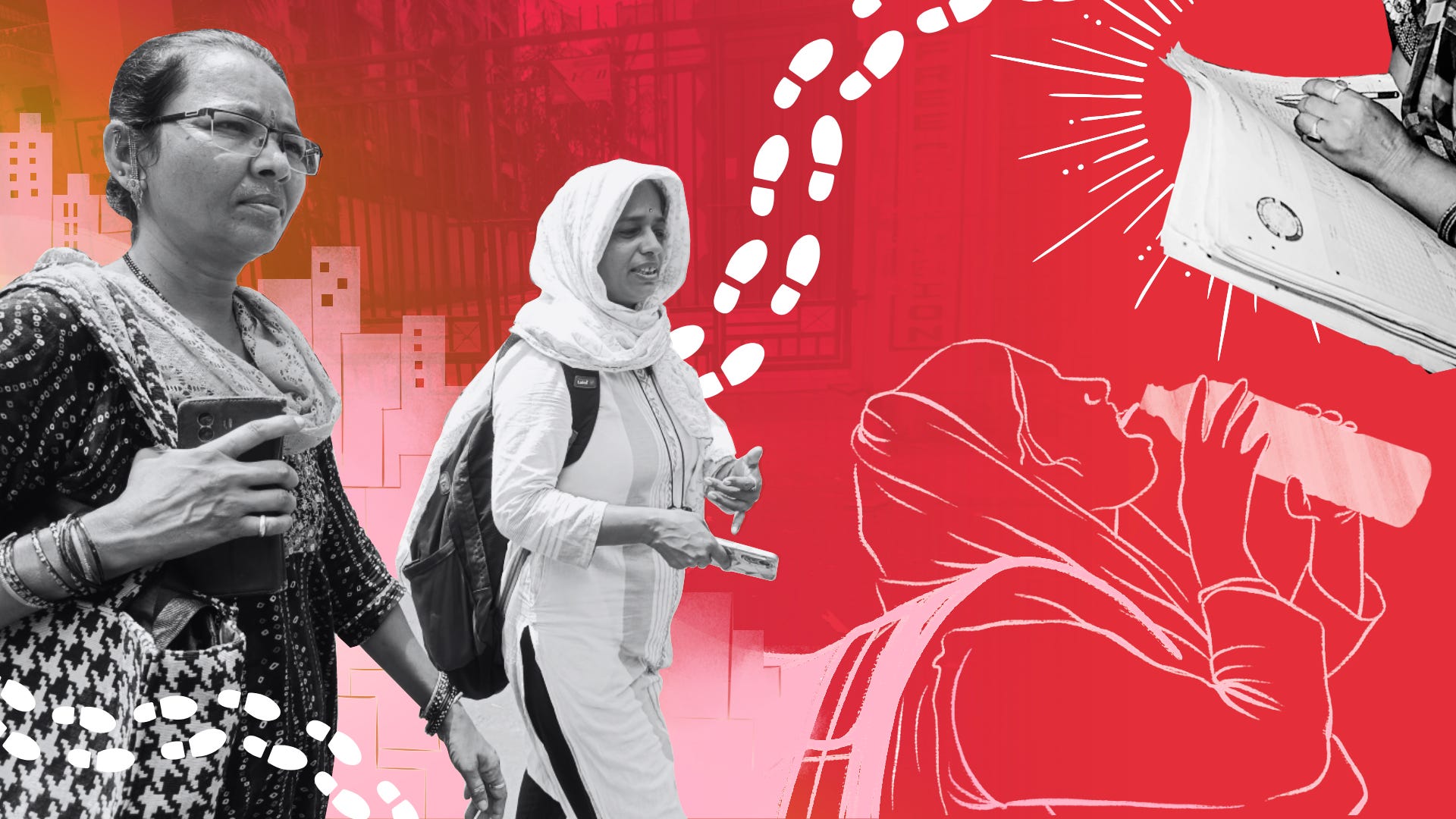
The ASHA workers on Census duty in Mumbai have been given a “kit” – a thin white cap, a bunch of pens and a bag so tacky it cannot hold a bottle of water. Out in the afternoon sun that often burns at 40 degree Celsius and enervating humidity, they have to bank on their survival instincts and the solidarity of their colleagues to protect themselves from heat stroke.
“What do we do if our work timings are 9am to 2pm? We cannot miss work. Our payments have already been withheld for months without any reason. Even if we take leave because we are sick we are not paid,” says Trupti Praveen Manjalkar, 37, who manages the health of 4,000 in Warli’s Jijamata Nagar, a predominantly Dalit neighbourhood.
In Maharashtra Nagar’s bastis in Mankhurd, Ranjeeta Awale, 37, and Vanita Rajendra Detake, 45, weave through the lanes, completing their Census round for the day, their heads covered with dupattas. Many of the doors are locked, for one this is the middle of a working day and then, it is vacation time, the month when many migrant families leave the city to visit their home towns and villages.
A 2025 HeatWatch report on ASHA workers suggested climate safety kits and infrastructure, mandatory heat breaks during the day, clear restrictions on scheduling ad-hoc work during summers, and the development of heat action plans in consultation with ASHAs workers. None of these ideas, we saw on the field, had been implemented.
And when the heat abates, monsoon mayhem will set in, flooding the basti roads, pushing garbage around, the sewage water mixing with rain. Through all this the ASHA workers on Census duty will have to trudge filling in survey documents.
“Yevda varsha, oon, paus, vaara, aghadi thandi, hya sagdya goshti chi parva nahi karta, aarogyasevika hya kaam kartat (despite this much heat, rain, wind and extreme cold, health workers have set aside their own wellbeing and done their work for years),” she says matter-of-factly.
The workers pay for their own water, drink as little of it as possible, carry ORS, call respondents instead of visiting them and sometimes pool in resources to buy a fan at the health post where they report. And, bank on the kindness of the households that they visit. Women who are menstruating or dealing with menopause have it hardest.
Read our story here.

Most of us think that on demand platforms for domestic workers is a recent development, an idea that took off after Urban Company’s Instahelp was launched. But by 2023 there were already few experimental start-ups, such as Beegle in Bengaluru and MaidHub in Pune, though organised through placement agencies, website-based services, and telephone networks, says researcher Hitesh Poddar in an essay for BehanBox.
The new platforms came with the promise of change – a tool to enable workers to maximise earnings, optimise their day, enjoy flexibility and work within a structure of almost formal employment and the dignity that brings. What they did was to perpetuate and exacerbate old domestic labour systems of inequities and exacerbation. It has left workers overworked, exhausted, and in little control of their day.
For Shanti*, this intensity is both enabling and exhausting. She migrated to Mumbai after a family crisis, carrying debt and responsibility for three children. On the platform, she works nearly 12-hour shifts earning about Rs 1,000 a day. Within months, she repaid her loan, brought her children to the city, enrolled them in school, and improved her rented home. But the costs are evident– significant weight loss and persistent joint pain that often requires medication to sleep.
There is a broader shift in how domestic work is organised and mediated today in Indian cities, through apps and algorithms.
Read our story here.


Cinema: A report two years ago by Ayesha Minhaz in Frontline had pointed to how the Telugu film constantly rehashes some of the most sexist, misogynistic, and patriarchal cinematic tropes in Indian cinema. This, she said, includes rape jokes, forced nudity, scenes of sexual assault and so on. A latest Telugu release, Peddi -- tailored for all-India release and directed by Buchi Babu Sana and featuring Jahnavi Kapoor and Ram Charan -- and featuring gratuitous scenes hypersexualising the female lead, and ignoring questions of consent, reconfirms this criticism. This time however young viewers have expressed their disgust at this school of filmmaking. And unusually enough, the director has not just issued an apology but also promised edits to the film. All of which we hope will make some difference.
Standing Up: It is one of the worst kept secrets of the standup circuit that for male comedians, sexist jokes with a dash of incel angst make for a fast path to popularity both on social media and on stage. But this week, comedian Pranit More and his highly objectionable interactions with his audience at an event in Gurgaon clearly crossed way too many boundaries. A viral video of casual sexism and entitlement made its rounds, followed by massive backlash, and then a particularly vicious audience member lost his job and More went incommunicado after a vapid apology. Will this make a difference to how many young men actually think and talk? No, but for the while the fury is quite satisfying.
Nation Builders: In 2023, we wrote about the courts’ failure in meaningfully recognising women’s labour at home. A Supreme Court judgment this week has assuaged some of those concerns, recognising women as “nation builders” and putting the minimum value of a homemaker’s unpaid care work at Rs 30,000. The work makes possible economic activity and has a negative effect on women’s labour force participation, the bench noted in the accident compensation case. And still, it remained shy of pushing for redistributing care work, reinforcing the gender norm that only women are duty bound to provide care.
Iran To US To CAR: Among the two dozen migrants the Trump administration is planning to deport to the poverty and conflict-ridden Central African Republic are two Iranian women who had sought refuge in the US, the NYT reports. The women have no criminal record and were granted protection from deportation to Iran where they fear persecution for ideological reasons.
Afghan Women Protest: In a rare protest in Herat, both men and women had marched last week against the harsh Islamic dress code imposed by the Taliban. The Taliban police opened fire on the protestors who were campaigning against the arrest of women accused of "improperly wearing the hijab". A BBC report says that the firing left two persons dead and many injured.
Reading Room: In Chengdu, in southwest China, a small community of women can now enjoy the pleasures of a small feminist bookstore, reports the Guardian in the first of a four-part series on women and society in China. Set up by Shen Shen, 42, it features books by feminist authors from across the world such as Judith Butler, Simone de Beauvoir and Chizuko Ueno. There are also small discussion groups that talk about gender issues. This may not seem like a rebellious act elsewhere but in China, feminism often attracts the charge of provoking “gender antagonism” between men and women. As in other parts of the world, the political leadership here is pushing for a return to traditional family values and roles for women, says the report.


As you step into the weekend, let us recommend some fun, witty as well some sobering reading and listening.
The Devil’s Child: Mako Nishimura fought her way into the Japanese underworld, but drug addiction and the slow demise of organised crime gangs almost destroyed her. Yakuza, that’s what the Japanese mob are called.
A City By the Working Class: Faridabad, a satellite town of Delhi, has fascinating socialist history, one that was built by the refugees rendered homeless by the Partition. Read this fascinating account of a city that is at once a study of history, tensions between socialism and capitalism, governmentality and above all the promise of idealism.
Not Today, Hades: Just what happened after Icarus flew too close to the sun? Or is there per chance a neglected compassion in the sordid profession of Cereberus, the three-headed dog that guards the underworld? This American Life podcast spins the wheel of time and profiles people living Greek myths in real time. A divine recommendation indeed.

Want to explore more newsletters? In Postcards, we send you missives on the places, people and ideas that brought Team BehanBox joy. Our monthly offering Postscript invites you, the reader, into our newsroom to understand how the stories you read came to be – from ideation to execution. Subscribe for more.